
NJ boat safety certificate vs boat license differences are the most misunderstood regulations on the water today. Thousands of new boaters assume that taking a class and passing an exam covers them completely, but depending on where they launch their vessel, they might be breaking the law.
New Jersey operates on a strict two-part credential system. The document you need is dictated entirely by whether you are boating on tidal waters (the ocean and bays) or non-tidal waters (inland lakes and reservoirs).
If you do not understand the critical NJ boat safety certificate vs boat license distinction, you run a high risk of being pulled over and fined by the marine police. This comprehensive guide breaks down exactly what each document is, where you need them, and how to stay completely compliant.
Table of Contents
- The Core Differences: NJ boat safety certificate vs boat license
- Tidal Waters: When Only the Certificate is Required
- Non-Tidal Waters: When the Boat License is Mandatory
- Practical Scenario: The Weekend Boater
- Step-by-Step Instructions to Get Both Credentials
- The Legal Statutes for NJ Boating Credentials
- Frequently Asked Questions
- Get Certified
The Core Differences: NJ boat safety certificate vs boat license
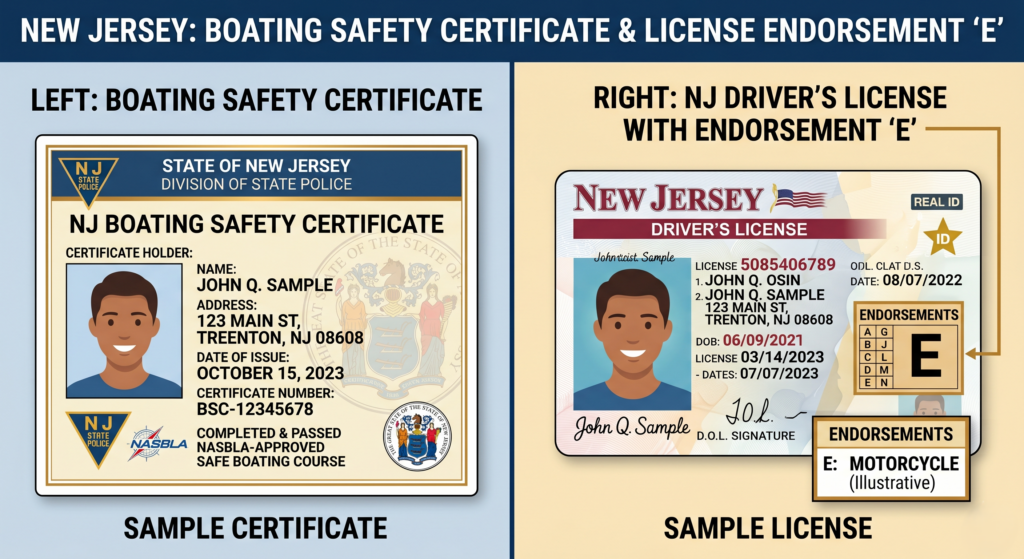
To navigate the legal landscape safely, you must clearly distinguish between the two documents. They are not interchangeable.
- The Boating Safety Certificate: This is an educational credential. It proves you have successfully passed a state-approved boating safety course and an in-person, proctored exam. It is a standalone plastic card issued by the state police.
- The Boat License (Endorsement): This is an administrative credential. It is an actual endorsement (the letter “E”) printed directly onto your standard New Jersey driver’s license by the Motor Vehicle Commission (MVC).
Tidal Waters: When Only the Certificate is Required
When operating a motorized vessel on tidal waters, the NJ boat safety certificate vs boat license rules are straightforward.
Tidal waters are defined as bodies of water where the tide actively changes due to oceanic influence. Examples include the Atlantic Ocean, Barnegat Bay, and the coastal portions of major rivers.
- To operate a powerboat or jet ski on tidal waters, you only need the Boating Safety Certificate.
- You do not need the MVC driver’s license endorsement.
- There are no exceptions based on vessel size or horsepower; the safety certificate is universally required for all power vessels here.
Non-Tidal Waters: When the Boat License is Mandatory
Non-tidal waters are where the NJ boat safety certificate vs boat license confusion usually happens.
Non-tidal waters are inland, freshwaters where the tide does not fluctuate. This includes popular recreational destinations like Lake Hopatcong, Greenwood Lake, and inland reservoirs.
- To legally operate on these lakes, you must carry your Boating Safety Certificate AND have the Boat Endorsement (“E”) on your driver’s license.
- Presenting only the educational certificate to marine police on a lake will result in a violation.
- You must be at least 16 years old to obtain this endorsement from the MVC.
Practical Scenario: The Weekend Boater
Imagine you live in Toms River and take a state-approved class to get your Boating Safety Certificate. On Saturday, you take your powerboat out onto Barnegat Bay (tidal water). Because you have your certificate onboard, you are completely legal.
The following Saturday, you decide to trailer your boat up to Lake Hopatcong (non-tidal water). If you launch your boat without first visiting the MVC to add the “E” endorsement to your driver’s license, you are operating illegally. The NJ boat safety certificate vs boat license law dictates that inland freshwaters require both the certificate and the MVC endorsement.
Step-by-Step Instructions to Get Both Credentials
Follow these specific steps to ensure you acquire the necessary documentation without any issues.
- Take the Safety Course: Enroll in an approved online or in-person boating safety course.
- Pass the In-Person Exam: Sit for your mandatory, proctored final exam to earn your physical Boating Safety Certificate.
- Identify Your Boating Location: Determine if you will exclusively boat on the ocean/bays (tidal) or if you will visit inland lakes (non-tidal).
- Visit the MVC (If Necessary): If you plan to boat on non-tidal lakes, schedule an appointment at an official MVC Licensing Center.
- Get the Endorsement: Present your Boating Safety Certificate, 6 points of ID, and the $18 fee to get the “E” endorsement printed on your driver’s license.
The Legal Statutes for NJ Boating Credentials
The New Jersey State Police Marine Services Bureau enforces these specific documentation laws across the state. Under N.J.S.A. 12:7-61, all operators of power vessels must possess a boating safety certificate.
Furthermore, N.J.S.A. 12:7-72 mandates that anyone operating a power vessel on non-tidal waters must possess a valid boat license issued by the Motor Vehicle Commission. Failure to produce both documents on non-tidal waters can result in fines ranging from $100 to $500 for a first offense. For official legal definitions, you can review the NJ State Police Marine Services portal or the New Jersey MVC website.
Frequently Asked Questions
Is the Boating Safety Certificate the same thing as a boat license?
- No. The certificate proves you took a safety class. The boat license is a legal endorsement on your driver’s license required for non-tidal waters.
Do I need the MVC boat license to drive a jet ski in the ocean?
- No. For tidal waters like the ocean and bays, you only need the Boating Safety Certificate.
Can a 13-year-old get a boat license in New Jersey?
- No. A 13-year-old can take the class and earn a Boating Safety Certificate for restricted vessels, but you must be 16 to get the MVC boat license.
Does my Boating Safety Certificate expire?
- No. Your Boating Safety Certificate is good for life and never needs to be renewed.
Get Certified
Ready to clear up the confusion and get completely legal on the water? The first step for everyone is earning that educational certificate.
Register for a BoatSafe US class today to complete your safety training. Be sure to check our local exam locations to easily schedule your proctored test.