
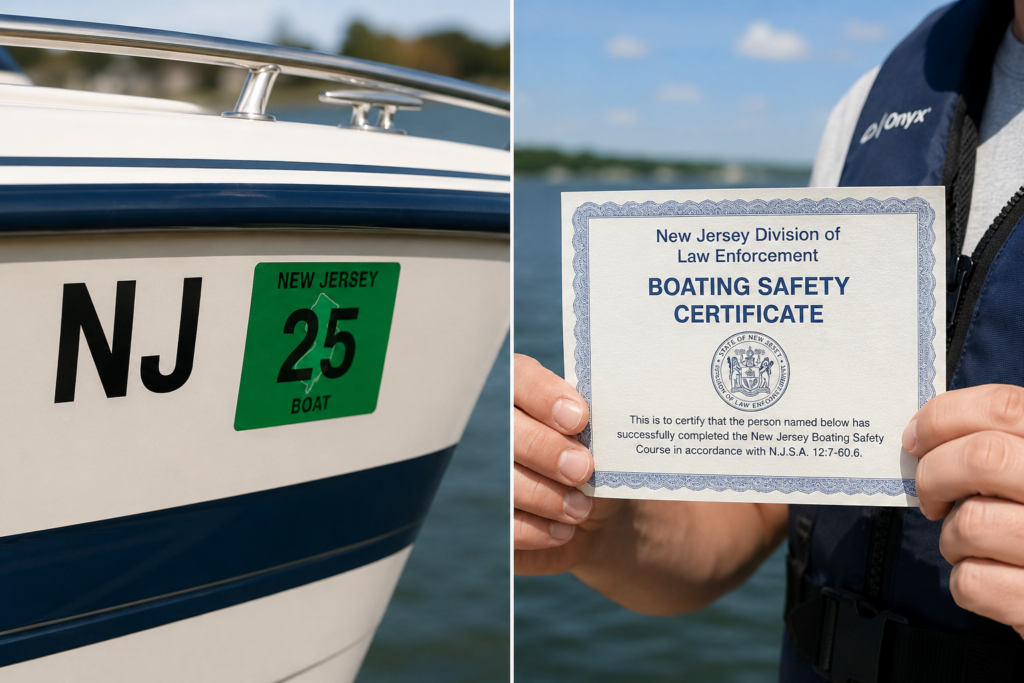
NJ boat registration vs license is one of the most common hurdles for new boaters. Every spring, thousands of residents purchase their first watercraft and mistakenly believe that because they registered the boat and paid the state fee, they are automatically allowed to drive it. Conversely, many students pass their safety exam and assume they can throw any unregistered boat into the water. In New Jersey, the law strictly separates the paperwork required for the vessel from the educational credentials required for the person driving it. Confusing these two distinct requirements will guarantee a severely disrupted weekend on the water and heavy financial penalties from marine enforcement.
For a full overview of course options and exam locations, see our NJ Boating License Guide.
What is the NJ Boat Registration vs License Confusion?
The confusion stems from how people talk about cars versus boats. When you get a driver’s license for a car, you go to the New Jersey Motor Vehicle Commission (MVC). When you buy a car, you also go to the MVC to register the plates. Because both tasks happen in the same building, people tend to blend the concepts together and assume a single trip covers all legal requirements.
However, in the boating world, these are two entirely different legal processes governed by different agencies and different sets of rules. A boat registration is a physical document and a set of exterior decals assigned to the hull of the boat to prove legal ownership and track the vessel. A boating license which in New Jersey consists of a lifetime Boating Safety Certificate and a non-tidal driver’s license endorsement is the educational credential assigned to the human being operating the vessel. You must possess both to legally enjoy the state’s coastal waterways and inland lakes.
4 Vital Differences
1. The Vessel vs. The Operator
The most fundamental difference is what exactly is being regulated. An NJ boat registration applies strictly to the physical piece of machinery. It acts essentially like your car’s license plate and title. It proves that taxes have been paid, the boat is legally owned, and it is authorized to be floating on state waters.
The boat license, on the other hand, applies exclusively to the human operator. Your New Jersey Boating Safety Certificate proves that you, the captain, have successfully completed a state-approved educational course, passed an in-person proctored exam, and understand the complex navigational laws of the waterways. A boat can be perfectly registered in your name, but if the person behind the wheel does not possess their operator’s license, the voyage is entirely illegal.
2. Where You Go to Get Them
The agencies responsible for issuing these credentials are completely different, which often causes major administrative headaches for new boaters. To secure your boat registration, you must deal directly with the New Jersey Motor Vehicle Commission (MVC). You must bring your proof of ownership, a bill of sale, and pay the appropriate registration fees to receive your physical hull decals and registration card.
Conversely, the educational boating license is overseen by the New Jersey State Police (NJSP) Marine Services Bureau. To obtain this, you do not simply pay a fee at a desk. You must register with an approved private course provider, sit through the mandated educational hours, and pass a supervised final exam. Only after passing the exam will you receive your permanent Boating Safety Certificate.
3. Strict Expiration and Renewal Timelines
Another massive difference lies in how long these documents remain valid. A boat registration is a recurring financial and administrative obligation. Boat registrations must be renewed periodically (usually annually), requiring you to pay ongoing fees to the state to keep the vessel’s paperwork current. If your registration sticker expires, marine police will immediately pull you over.
Your educational credentials operate on a completely different timeline. The New Jersey Boating Safety Certificate is a permanent, lifetime credential. Once you pass your exam and receive your plastic card from the state police, it never expires, and you never have to pay a renewal fee or retake the test. If you boat on non-tidal freshwaters, you must add an endorsement to your driver’s license, but even that simply renews seamlessly alongside your standard vehicle driver’s license schedule without requiring you to take another boating test.
4. The Broad Scope of the Requirements
The laws dictating who needs these documents vary wildly. Almost every single motorized boat in New Jersey, regardless of length, must be registered with the MVC. Additionally, any boat longer than 12 feet, whether it has a motor or is just a large sailboat, must be titled and registered. The law focuses heavily on getting the vessel itself into the state’s tracking system.
However, the laws regarding the operator’s license focus entirely on age and propulsion. Any individual aged 13 or older operating a motorized vessel on state waters must hold a Boating Safety Certificate (and operators of personal watercraft must be at least 16). This means if you let your neighbor, your cousin, or your 17-year-old child drive your perfectly registered boat, they must independently hold their own safety certificate. The registration covers the boat, but every single person who takes the wheel must possess their own educational license.
Where to Take the NJ Boat Exam
While you must visit the MVC for your registration, the NJ boating safety exam must be taken in person through an approved course provider.
You can browse available NJ boating safety exam locations here.
Ready to Get Your NJ Boating License?
If your boat is registered and you are ready to complete your required boating safety exam to legally take the wheel, you can easily browse available NJ boating safety exam locations across the state.
View upcoming NJ boating safety exam locations and register today.